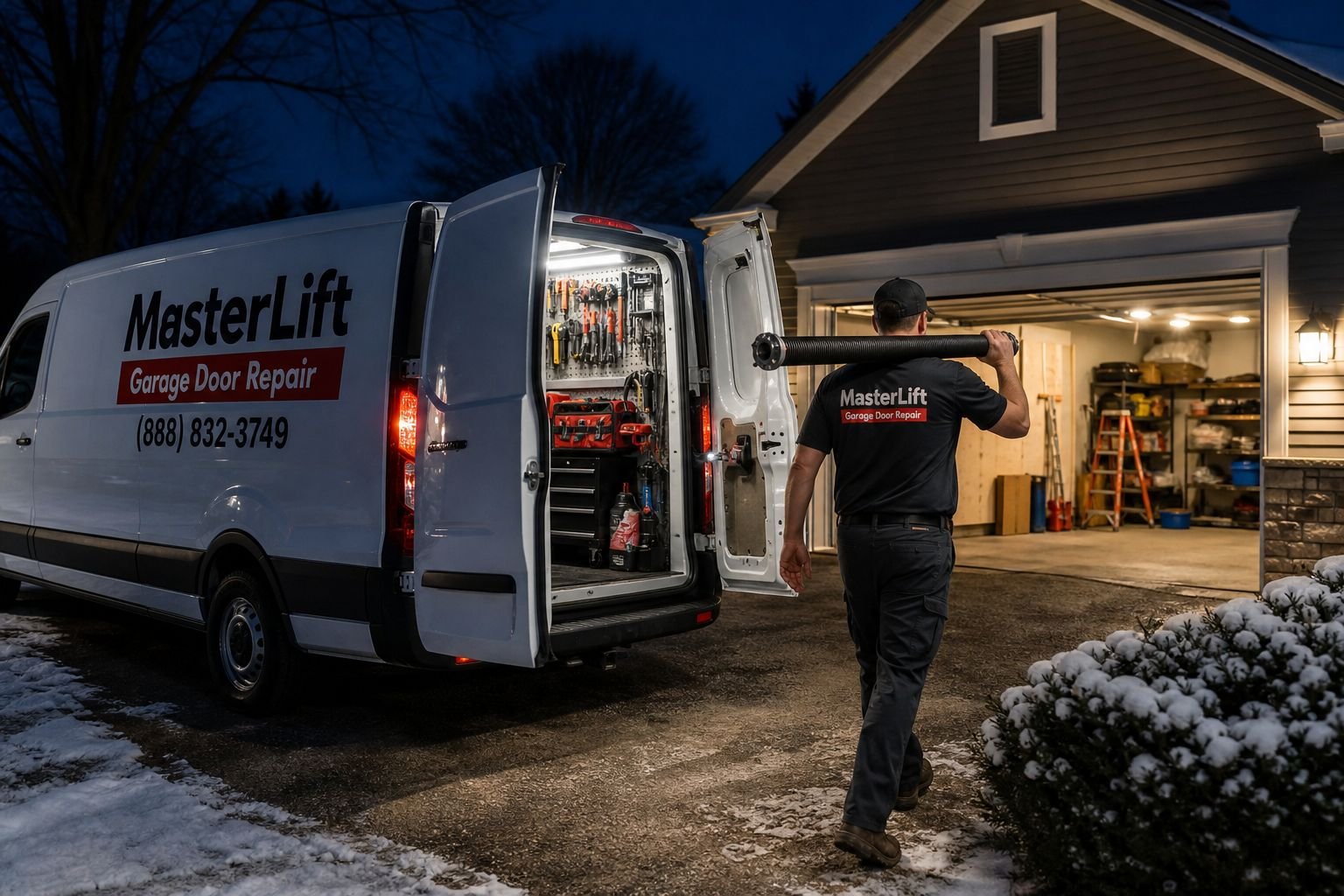
We have been running service calls into Portland long enough to know which streets have detached garages set back off the road, which have tuck-under bays with no headroom, and which were built out in one decade and are now all failing at once.
Out Route 2 then south on Route 17. Twenty-five minutes. Our technicians carry torsion and extension springs in the common sizes, cables, rollers, hinges, bottom brackets, weather seal and the logic boards for the openers people actually own. Roughly nine calls in ten are finished on the first visit.
Everything is backed by a written warranty on parts and labor, and there is no charge for the estimate whether you go ahead or not.
What garage doors in Portland actually look like
River town with older housing near the center, brownstone-era homes with detached structures, and newer builds up toward Cobalt.
We work across Portland Center, Gildersleeve, Cobalt and Brownstone, and the difference between them is real enough that we ask which part of town you are in before quoting.
The local quirk worth knowing
The brownstone foundations common in the older part of town shift more than poured concrete, and a garage floor that has moved throws the door out of square. Squaring the opening comes before adjusting the door.
What we get called out for most
- Out-of-square openings on settled foundations
- Detached garage work
- Opener replacement
Knowing the pattern is half the job. It means we arrive with the right parts instead of arriving to look.
The three kinds of garage door we see in Portland
There is no single typical Portland garage door. There are three, they were built decades apart, and they fail in completely different ways.
The subdivision housing
Wide attached garages, sixteen or eighteen feet, insulated steel on torsion springs. Mechanically the most straightforward doors we work on, and also the hardest worked, because the garage is the front door in these houses. A fifteen-year-old build is usually still on its original springs and usually well past their rated cycles.
The older village stock
Freestanding garages set back from the road, narrow openings, and framing that predates any modern door by decades. The constraint is almost always headroom, which is why these need low-headroom or double-track hardware rather than whatever comes in the box. Getting the spring sized to the actual door weight matters more here than anywhere.
The post-war capes and ranches
Single attached bays, nine or sixteen feet wide, almost all of them originally fitted with extension springs and a chain-drive opener bolted to the joists. Most have been re-doored at least once. The recurring fault here is a header that has taken forty years of vibration and an opener mounted into joists that were never blocked properly.
The practical upshot is a stocked van rather than a diagnostic visit followed by a second appointment to actually fix it.
Getting to you in Portland
Twenty-five minutes from base. We run Route 66, Route 17, Route 17A and Main Street to move around town, so we know where the bottlenecks are at four in the afternoon.
Coverage in Portland takes in 06480. If your ZIP is not on that list you are almost certainly still inside our radius, so call and we will tell you straight away.
We are out past the Brownstone Quarry, the Connecticut River and Wangunk Meadows most weeks.
For genuine emergencies in Portland, a door stuck open, a spring that has snapped, a car trapped behind a door that will not lift, we dispatch immediately rather than slotting you into a queue. Call (888) 832-3749 and say it is urgent.
What Connecticut weather does to a garage door
Almost every winter emergency we attend in Portland traces back to the same physics. Steel contracts in cold. A torsion spring that has been cycling for eleven years has microscopic fatigue cracks along the wire, and a hard freeze is what finally opens one up. That is why we take four times the spring calls in January that we take in July, and why they cluster on the first genuinely cold morning after a mild stretch.
The Connecticut River valley moderates things a little, but not enough to matter once the temperature drops below twenty.
Spring thaw and the slab
Freeze-thaw cycles lift and settle concrete, and a garage slab that has heaved even half an inch changes where the door meets the floor. The symptom is a door that seals on one side and shows daylight on the other, or one that reverses off an uneven threshold. A new bottom seal and a re-set down-limit usually solves it without touching the slab.
Cold
Below freezing, the grease in old rollers and bearings stiffens into something closer to wax. The opener reads that resistance as an obstruction and reverses, or it forces through and strains the gear. People assume the opener has failed. Usually it has not, and a proper lubrication service with a lithium-based product fixes what looked like a four-hundred-dollar problem.
Ice at the threshold
Melt water runs under the door during the day and freezes to the slab overnight, bonding the bottom seal to the concrete. In the morning the opener pulls against a door that is physically stuck to the floor. Best case it stalls. Worst case the bottom section tears or a cable jumps the drum. If your door will not lift on a cold morning, do not hold the button down. Break the seal at the edges with warm water first.
Salt
Road salt tracks into the garage on tires and sits on the track feet, the bottom brackets and the lower hinges all winter. In Portland we see galvanizing fail on hardware that is only six or seven years old because of it. Rinsing the bottom eighteen inches of the assembly a couple of times over the winter genuinely doubles the life of those parts.
Wind and pressure
Nor'easters and the remnants of tropical systems both push hard against a door that is, structurally, a large flat sail. Older single-skin doors bow visibly in a strong gust and the bowing works the rollers against the track lip. If your door has started rattling in high wind where it never used to, the track brackets have usually loosened.
Summer humidity
The other end of the year has its own problem. Wooden doors and wooden jambs swell through July and August until the door binds in the opening, and homeowners crank up the opener force to compensate. That works until the humidity drops and the force setting is now high enough to be genuinely dangerous. We reset force limits seasonally on any wood installation we maintain.
Reading the symptoms yourself
Nobody expects you to know what a travel module is. But garage doors fail in a fairly short list of ways, and a clear description of the symptom usually tells us which part to bring.
One side hangs lower than the other
Anything that leaves the door sitting crooked in the opening is a load-path problem: one lift cable is no longer doing its share. Left alone it bends track, chews rollers and eventually cracks a panel. Disconnect the opener and call rather than trying one more cycle.
It reverses just before it touches the ground
This is a settings problem far more often than a hardware one. Check the photo-eyes first because they cost nothing to fix, then the down-limit and close-force. What you should not do is wind the force up until it stays down, which is how people disable the safety system without meaning to.
Loud bang from the garage, door still closed
A single sharp report with nothing obviously fallen over is almost always a torsion spring failing. Neighbors sometimes hear it before the homeowner works out what it was. Do not test it by lifting the door: with the spring gone you are holding the entire weight yourself.
Grinding, scraping or a rhythmic squeal
A repeating squeal timed to the door's travel points at rollers or hinges; a harsher metallic grind points at a bearing or the opener's drive gear. Both are cheap now and expensive later, because a dragging roller wears the track it is dragging on.
The remote works but the wall button does not, or the reverse
Worth checking the lock button before anything else, because vacation mode disables remotes while leaving the wall control live and people trigger it by accident constantly. If that is not it, the split tells us whether to look at the wiring run or the receiver.
Please do not do this one thing
One firm exception to any DIY inclination: the springs. They are wound under enormous tension, they release all of it at once when something slips, and the tooling sold online is frequently the wrong diameter for the cone it is going into. This is the job that puts people in emergency rooms.
Call (888) 832-3749 insteadGarage door services we run in Portland
Everything below is available in Portland at the same price we charge in West Hartford. Your ZIP code does not change the invoice.
- Garage Door Repair in Portland — from $89. Broken springs, snapped cables, dead openers, dented panels, doors that grind or stop halfway. This is one we carry parts for on every van.
- Spring Replacement in Portland — from $189. A torsion spring stores enough energy to break bones. Booked before early afternoon, this is normally finished the same day in Portland.
- Opener Repair & Installation in Portland — from $129. Chain, belt, screw drive, wall-mount and Wi-Fi models. This is one we carry parts for on every van.
- Cable & Drum Repair in Portland — from $149. Frayed or jumped cables let one side of the door drop and twist the whole assembly out of square. Most Portland calls for this land the same day.
- Off-Track Repair in Portland — from $149. A door off its track is holding hundreds of pounds in the wrong place. Most Portland calls for this land the same day.
- New Door Installation in Portland — from $899. Steel, insulated steel, carriage house, full-view aluminum and wood. Most Portland calls for this land the same day.
- Panel Replacement in Portland — from $279. One backed-into panel does not mean a whole new door. Typical turnaround on this in Portland is a single visit.
- 24/7 Emergency Service in Portland — from $149. Door stuck open at midnight with the house exposed. Booked before early afternoon, this is normally finished the same day in Portland.
- Commercial Doors in Portland — from $189. Rolling steel, sectional overhead, high-cycle dock doors and fire-rated shutters. Booked before early afternoon, this is normally finished the same day in Portland.
Anything unusual, keypads, jackshaft conversions, high-lift track, fire-rated shutters, we handle too. Just ask.
What it typically costs in Portland
We publish these because the alternative, a vague headline figure and a conversation in your driveway, is how this trade earned its reputation. Where your Portland job lands in a range comes down to door weight, cycle rating and what we find behind the cover.
| Job | Typical range | What that covers |
|---|---|---|
| Service call and full diagnosis | Free with any completed repair | No trip charge on a completed repair |
| Torsion spring replacement (pair) | $189 – $340 | Matched pair, rebalanced and safety-tested |
| Extension spring replacement (pair) | $149 – $260 | Includes safety cables if missing |
| Cable replacement (pair) | $149 – $240 | Drums and bearings inspected |
| Roller replacement (set of 10) | $110 – $210 | Sealed-bearing nylon, much quieter |
| Off-track recovery and realignment | $149 – $320 | Bent sections straightened or replaced |
| Opener repair | $129 – $290 | Most faults are a part, not a new unit |
| New opener supplied and fitted | $389 – $720 | Belt or chain, backup battery optional |
| Single panel replacement | $279 – $620 | Subject to the panel still being in production |
| New insulated steel door fitted | $899 – $2,400 | Includes removal and disposal of the old door |
After-hours work carries a modest premium and we tell you the figure on the phone before dispatching, never after arriving. Everything else in that table is the same rate at two in the afternoon as it is at two in the morning.
How to get someone out to Portland
Pick whichever suits you. The phone is fastest and gets you a person immediately on (888) 832-3749. The form at the top of this page produces a callback, usually within a few minutes during the day. Online booking lets you choose your own two-hour slot up to two weeks out.
Useful things to have ready
The make of the opener if you can see it on the motor housing. Whether the door is single or double width. Roughly how old it is. And plainly what it is doing, goes up a foot and stops, hums but does not move, closes then immediately reverses. Those descriptions map onto specific faults reliably enough that we usually know what to load before setting off.
What happens on the day
Expect a text with the technician's name and photo when they leave the previous job. On arrival they inspect before quoting, which means disconnecting the opener, checking the balance manually, walking both cables, spinning every roller and testing the reverse. Only then do you get a number, in writing, and only then does anything get touched.
When it is finished the door gets cycled, rebalanced and safety-tested again, the old parts go with us, and the warranty paperwork with photos lands in your inbox the same day. If anything is not right, call the office and we come back at our cost.
We also cover the towns next door
Plenty of Portland jobs get booked at the same time as a neighbor's, and the van is already in the area. Nearest coverage: Cromwell, CT · Middletown, CT · East Hampton, CT · Rocky Hill, CT · Berlin, CT · Wethersfield, CT · Glastonbury, CT · Marlborough, CT.