Telling them apart in five seconds
Stand inside the garage with the door closed and look up.
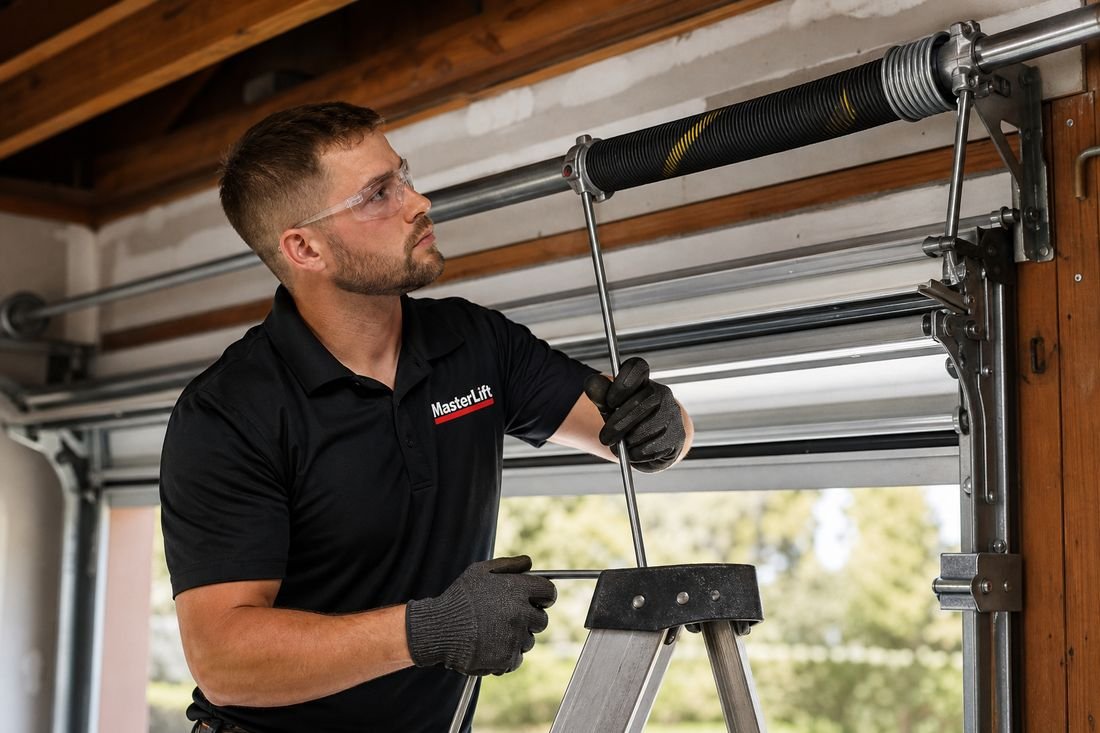
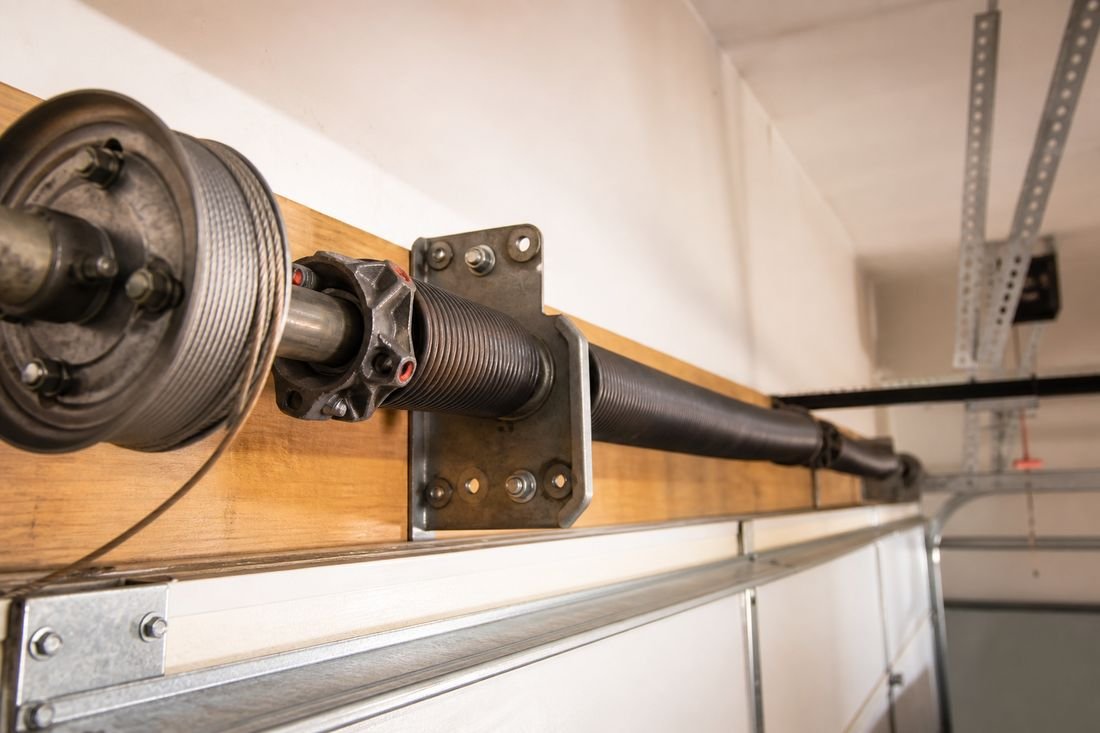
Torsion. A steel shaft runs horizontally across the wall just above the door opening, with one or two springs wound around it and a bracket anchoring them at the centre. Cables run from drums at each end of the shaft down to the bottom brackets of the door. This is what is on most doors installed in the last twenty-five years and on essentially every double-wide door.
Extension. Nothing above the opening. Instead there are two long, thin springs running horizontally back from the top of the vertical track, parallel to the ceiling and above each of the horizontal tracks. They stretch as the door closes. Common on older single-car doors and on lighter uninsulated doors.
A handful of doors have neither, usually one-piece tilt-up doors on side-mounted spring arms. Those are rare now and they are their own conversation.
How each one actually works
Both systems do the same job: store energy when the door comes down and give it back when the door goes up, so the opener is only overcoming friction rather than lifting 150 to 400 pounds of door.
A torsion spring stores it in twist. The spring is wound tight around the shaft, and unwinding turns the shaft, which turns the cable drums, which pull the cables that lift the door. Because the drums have a shaped profile, the amount of lift per degree of rotation changes through the travel, and a properly specified system keeps the door close to neutral buoyancy at every height.
An extension spring stores it in stretch. It pulls on a pulley system that pulls the cable. Simpler and cheaper. The trade-off is that the force from a stretched spring is close to linear, so the balance is only really correct at the extremes; an extension door often feels heavier in the middle of its travel.
The safety difference, which is the real one
When a torsion spring fails it stays on the shaft. The coil splits, you hear a bang like a rifle shot, the door drops or refuses to lift, and the broken spring is sitting exactly where it always was. Dangerous to work on, not dangerous to be near.
When an extension spring fails it is a stretched piece of steel with nothing restraining it. It becomes a projectile travelling the length of the garage. This is precisely why safety cables exist — a steel cable threaded through the middle of each extension spring and anchored at both ends, so a failed spring stays on the cable.
If you have extension springs, go and look right now for a cable running through the centre of each one. If there is not one, that is the single cheapest safety improvement available to you and it is not an upsell — it is a part that costs less than a takeaway. We fit them free on any extension-spring door we are already working on.
Cost, honestly
Extension springs are cheaper to buy and quicker to fit. Torsion springs cost more and take longer, because winding one safely requires proper winding bars and a technician who knows what quarter-turn count the drum needs.
In our area, an extension pair typically lands between $170 and $280 fitted. A single torsion spring runs $189 to $290; a matched pair, which is what a double door needs, runs $260 to $420. High-cycle torsion adds roughly thirty percent and buys two to three times the life.
The reason the gap is smaller than it looks: a torsion system lasts longer and treats the opener better. A well-balanced torsion door means the opener is doing almost no lifting, and openers that are not straining last years longer. Some of what you save on the cheaper spring you spend later on a gearbox.
Always replace in pairs
This applies to both systems and it is the piece of advice people most often push back on, because when one spring breaks the other one is visibly fine.
It is fine in the sense that it has not split yet. It is not fine in the sense that it has done exactly the same number of cycles as the one that just failed, and it is the same age, same gauge, same steel, same garage. Replacing one leaves you with a new spring and a spring that is statistically due. Worse, a mismatched pair loads unevenly, which wears the shaft bearings and pulls the door out of square over time.
The labour is already paid for on the visit. The marginal cost of the second spring is the part. Do both.
Should you convert extension to torsion?
Sometimes. The honest test is whether one of these is true:
- You are replacing the door anyway. A heavier insulated door often needs torsion regardless, and doing it at install costs almost nothing extra.
- Headroom allows it. A torsion system needs roughly twelve inches above the opening. Low-headroom kits exist but they add cost and complexity.
- The door is genuinely heavy or wide. Any double-wide door is better on torsion, full stop.
- You keep breaking extension springs. Repeat failures usually mean the springs are undersized for the door, and converting solves it properly.
If none of those apply and your extension system is balanced and safety-cabled, there is no reason to convert. Conversion runs several hundred dollars because it is new shaft, new drums, new cables, new bearing plates and a new anchor bracket. It is a worthwhile upgrade in the right situation and a waste of money in the wrong one, and any company that recommends it on every extension door is selling, not advising.
What never to do yourself
Both types store enough energy to kill. This is not marketing caution; broken-spring injuries are the main way people get seriously hurt by a garage door.
A torsion spring is wound to somewhere around seven and a half turns for a standard seven-foot door. Unwinding it without proper winding bars — and screwdrivers are not winding bars, they bend and launch — releases that in one movement, through your hands. An extension spring under load will travel the length of the garage if it lets go.
Diagnose it yourself by all means. Photograph the gap in the coil, count the springs, measure if you like. Then let somebody with the bars do the winding.