What R-value does and does not tell you
R-value measures resistance to heat flow through a material. A bare steel garage door is around R-0 to R-2. A polystyrene-filled door is typically R-6 to R-10. A polyurethane-injected door runs R-12 to R-18 or so depending on thickness.
Here is the catch. Manufacturers quote R-value for the section, measured through the middle of a panel. Your door is not a panel. It is four or five panels with joints between them, a gap at the top, a gap at the bottom, and gaps down both sides. Heat does not politely travel through the thickest part.
A well-sealed R-9 door in a properly weatherstripped opening comfortably outperforms a badly fitted R-16 door with a worn bottom seal and daylight at the jambs. If your budget forces a choice between a higher R-value and a proper seal package, take the seals.
Polystyrene versus polyurethane, which is the real decision
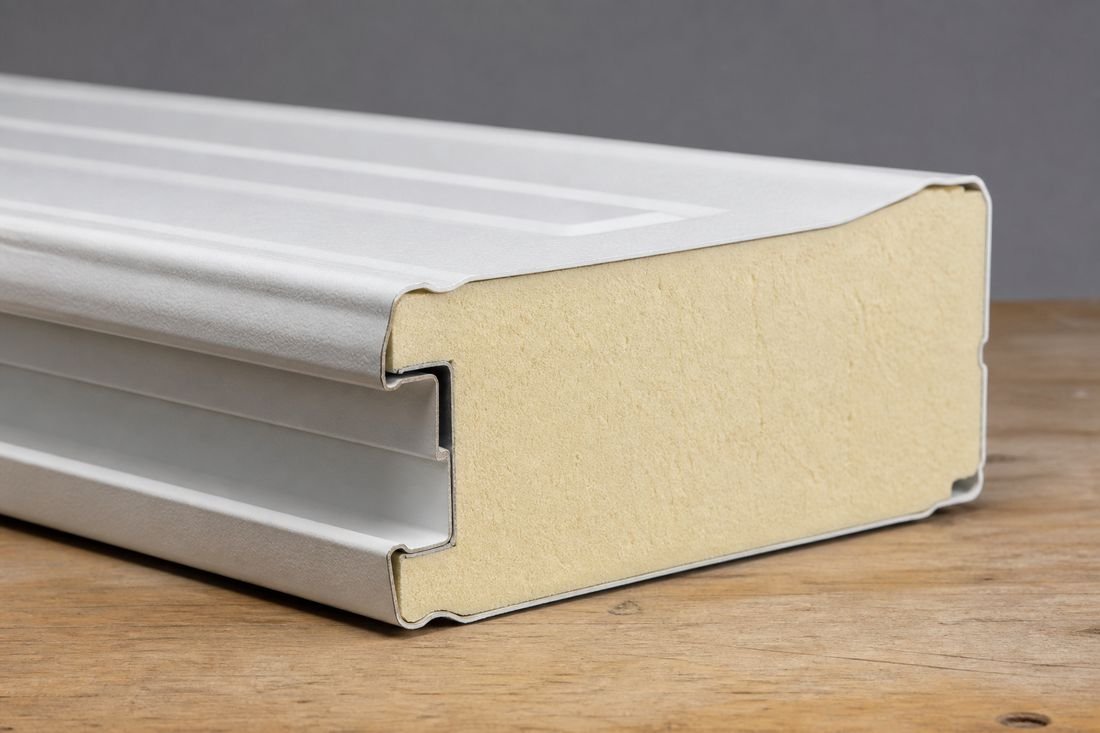
Polystyrene is rigid foam board cut to size and slid into the section. Cheaper. There are inevitably small voids around the edges where the board does not perfectly fill the cavity, and because the board is not bonded to both skins it adds nothing structural.
Polyurethane is injected as a liquid and expands to fill the cavity completely, bonding chemically to the inner and outer steel skins. Higher R-value per inch with no voids, and — the part nobody mentions in the brochure — it turns the section into a composite panel. A polyurethane door is substantially more rigid than a polystyrene one of the same gauge.
That stiffness is what most people actually notice. It resists denting, it does not flex and rattle in wind, and it is markedly quieter in operation. When customers tell us their new insulated door "feels expensive", they are describing panel rigidity, not thermal performance.
Does it pay for itself? Not in energy alone.
Be sceptical of anyone selling you an insulated door on energy savings. Here is the honest version.
Connecticut runs somewhere in the region of 5,500 to 6,000 heating degree days annually, which is a genuinely long heating season. So the physics is on the side of insulation here far more than it would be in Virginia. But the arithmetic depends entirely on one question: is the garage heated, and is it inside the thermal envelope of the house?
Detached, unheated garage. You are insulating a building you do not heat. The energy saving is approximately zero. Buy the insulated door for the rigidity, the quietness and the fact that your car is not sitting at ambient, but do not buy it on a payback calculation.
Attached, unheated garage with living space above or behind. This is the case that matters, and it is extremely common in Connecticut housing stock. The garage is a buffer zone. Keeping it ten or fifteen degrees warmer directly changes how much heat the bedroom above loses through its floor. This is where people actually feel a difference, and the complaint that prompted the call is usually "the room over the garage is always freezing."
Attached and actively heated. Obvious case. Insulate it, and do the walls and ceiling too, because the door is only one surface.
The parts of the opening that are not the door
If the room above the garage is cold, the door is one of five things to look at, and it is not always the biggest.
- Bottom seal. A hardened or cut astragal leaves a gap along sixteen feet. This is the single largest air leak on most garage openings and the cheapest to fix.
- Perimeter weatherstrip. The vinyl-flanged stop moulding round the jambs and header. If you can see daylight, it is doing nothing.
- Section joints. Better doors have a tongue-and-groove or thermal-break joint between sections. Cheap ones butt.
- The ceiling between garage and room above. Very often under-insulated or, in older Connecticut houses, not insulated at all.
- The door from garage to house. Frequently an uninsulated slab with no weatherstrip, which is both a thermal and a code issue.
We will tell you honestly when the door is not your problem. It happens often enough that we ask about the room above before quoting.
Weight, springs and your existing opener
An insulated door is heavier — often by a hundred pounds or more on a double. This matters in two ways people discover after the fact.
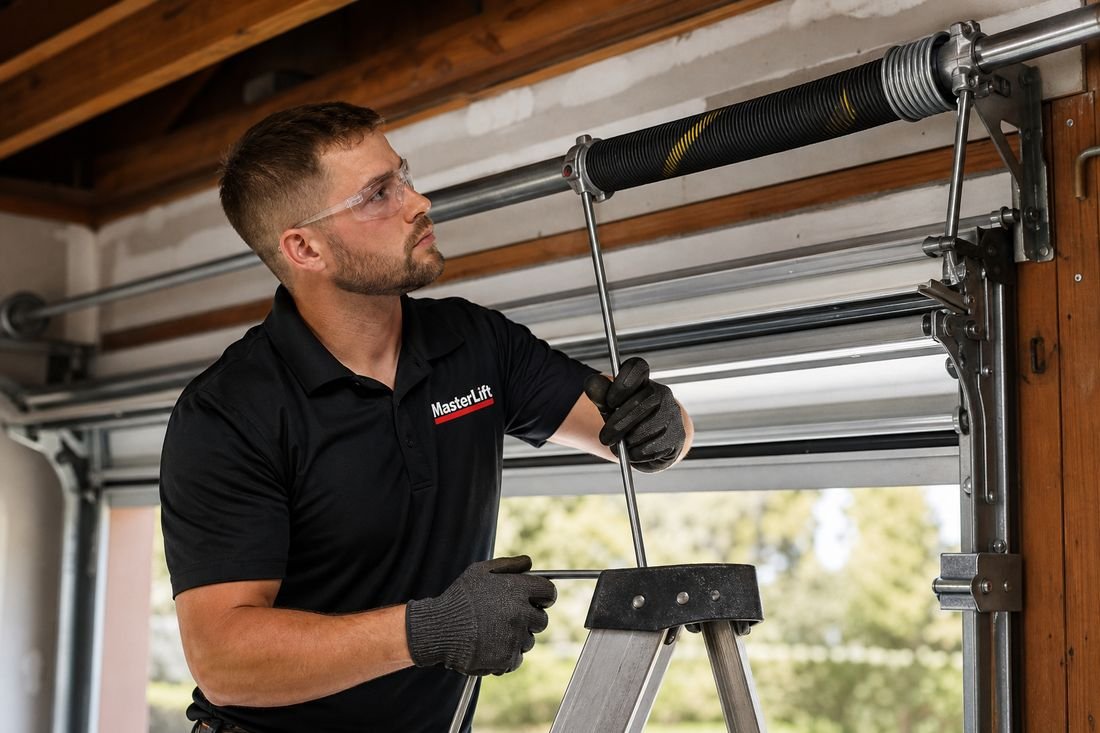
First, the springs must be re-specified. The springs on your current door are matched to your current door's weight. Hanging a heavier door on the old springs gives you a door that is out of balance, an opener that strains, and springs that fail early. Any quote for an insulated replacement that does not include new springs sized to the new door is not a complete quote. Ask.
Second, the opener may need looking at. A correctly balanced door should be liftable by hand regardless of weight, so a healthy opener on a properly sprung heavy door is usually fine. But an older half-horsepower chain drive that was already marginal will not enjoy it.
What we would actually specify
For an attached garage with living space above, in this climate: a polyurethane-cored steel door, two-inch section if the budget reaches, with a full seal package — new bottom astragal, new perimeter stop with vinyl flange, and thermal-break joints between sections. Nylon rollers on ball bearings rather than the steel ones that come as standard. New springs sized to the finished door weight.
For a detached unheated garage: insulate if you want the rigidity and quiet and can justify it on that basis, otherwise a good non-insulated door with a proper seal package is not a compromise. Put the money into the seals and the rollers.
Either way, the seals are not the upsell. They are the part that does the work.