First, stop using it
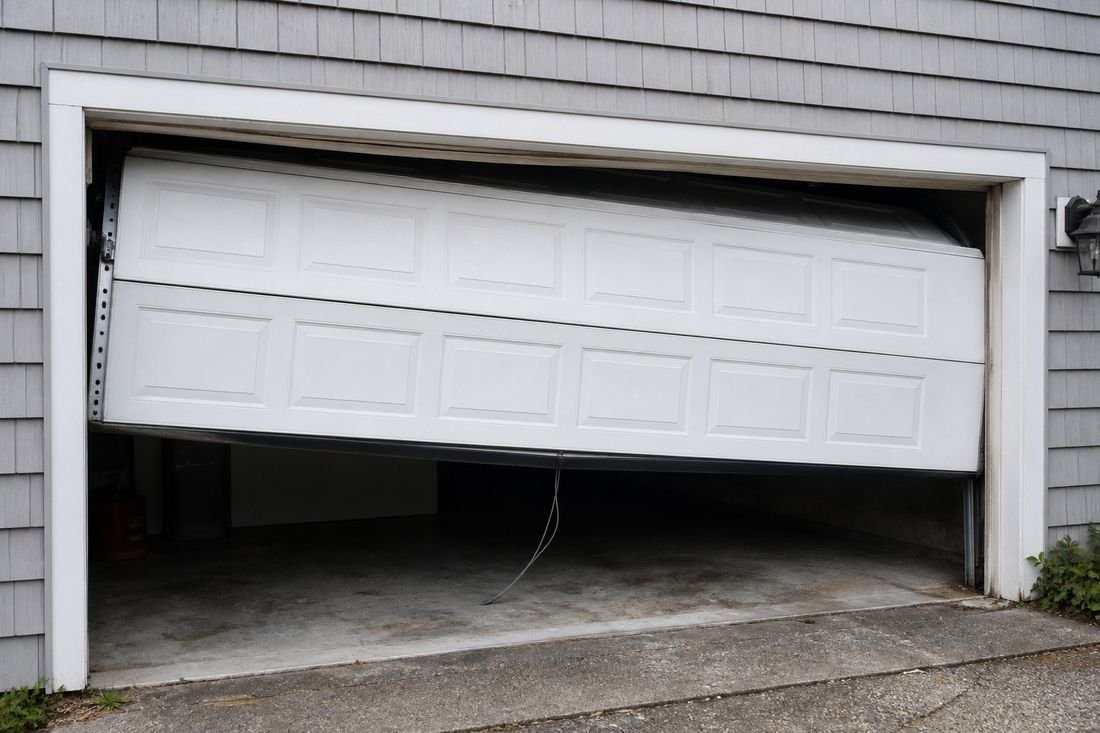
This is genuinely the important part. A crooked door is not a cosmetic fault, and unlike most garage door problems it gets worse with every cycle.
Here is why. The door hangs from two cables. When one loses tension, the whole weight transfers to the other side. The door racks in the opening, the rollers on the slack side start to bind against the track, and the track itself begins to deform. Every further operation bends more track, and can pull a roller out of the track completely, at which point you have gone from a cable job to a cable, track and possibly panel job.
Pull the release cord, leave the door where it is, and diagnose from there. If the door is up and crooked, do not walk under it.
Cause one: a cable has jumped off the drum
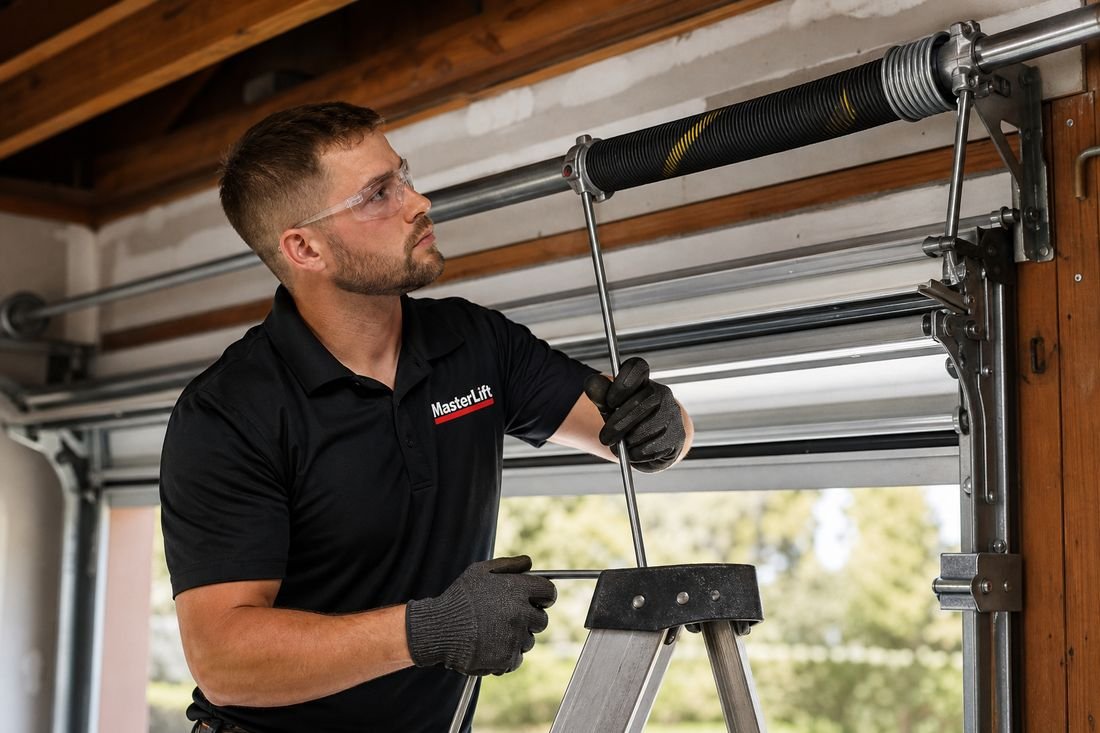
Far and away the most common. The lift cable spools into a grooved drum at each end of the torsion shaft. If the cable goes slack at any point — typically because the door came down onto an obstruction, or was closed onto something, or hit the floor unevenly — the cable can unseat from its groove and jump off.
The tell is a cable that is visibly loose, hanging in a loop, or wrapped over itself on the drum instead of sitting neatly in the spiral. The other side will look normal.
The repair is re-seating the cable and re-timing the drums so both spool identically. The re-timing is the part that requires a technician: the torsion shaft has to be unwound, the drums released, both cables tensioned equally, and the spring re-wound to the correct turn count. Doing that with the spring still loaded is how people get hurt.
Cause two: drum timing has drifted
Related but distinct. Both cables are on their drums correctly, but one drum has slipped on the shaft — usually because the set screws were not torqued properly at install, or have loosened over years of vibration.
The symptom is subtler: the door does not hang visibly crooked at rest but goes up progressively out of level, worst at the top of the travel. You often hear it before you see it, as a rubbing or scraping from one side.
Fix is the same procedure — unwind, re-time, re-tension, re-wind — plus properly torqued set screws, and a look at whether the shaft has been scored where the screws have been slipping.
Cause three: a cable has snapped
Unmistakable when it happens. There is a bang, one corner of the door drops sharply, and the door sits at an angle wedged in the opening.
Cables are galvanised steel and they fail from corrosion and fatigue, usually at one of two points: right at the bottom bracket where water sits, or where the cable turns onto the drum and flexes on every cycle. A cable that has snapped at the bottom bracket almost always means there is rust in the bottom section too, which needs looking at while the door is apart.
Always replace both cables. They are the same age, same environment, same number of cycles. Fitting one new cable against one aged one gives you unequal stretch and puts you back here in a year.
Cause four: the bottom bracket has pulled
Less common, more serious. The bottom bracket is the fitting at each lower corner where the cable attaches to the door. It carries the full lifting load on that side, and it is bolted into the bottom section — which is the section that sits on a damp concrete floor for twenty years.
If corrosion has weakened the steel around the bracket, the bracket can start to pull through. The door goes crooked because that corner is no longer being lifted from where it should be.
Bottom brackets are also under permanent spring tension, which is why they carry a warning label. They are not a component to unbolt out of curiosity.
This is the one case where the answer may be a new bottom section rather than a repair. If the steel around the fixing has gone, there is nothing sound to bolt into.
Things that look like this and are not
- The door is level but the gap along the floor is uneven. That is usually a settled or out-of-level slab, not a door fault. A wedge-profile bottom seal takes up the difference.
- The door is crooked only when closing, never when opening. Look at the photo-eyes and the tracks for an obstruction on one side.
- The door racks and there is a loud bang at one point in the travel. Often a bent track section or a roller that has lost its bearing, rather than a cable.
What a proper repair covers
Re-seating a cable and calling it done is a patch. When we take a crooked door apart we are looking at the whole load path, because a cable does not usually come off for no reason:
- Both cables, replaced as a pair, correct length and gauge for the door height.
- Drums re-timed and set screws torqued to spec, shaft checked for scoring.
- Bottom brackets inspected for corrosion and pull-through.
- Tracks checked for the deformation caused by however many cycles it ran crooked, and straightened or replaced.
- Rollers checked — a bound roller often has a flat-spotted or seized bearing afterwards.
- Spring balance re-tested, because the drums have been off.
- Safety reverse re-tested before we leave.
And crucially: finding out why the cable went slack. If the door was closing onto something, or the floor is out of level, or the down-force setting is high enough to keep driving after the door lands, it will happen again.